Overview
Tangrams started as a question: what if a classic puzzle could exist in the physical and digital worlds at once? The Glow’s dual-plane technology was unlike anything on the market—but it needed a killer activity to prove it. Something that could only exist on the Glow, and nowhere else.
Tangrams delivered that. Kids and their remote loved ones solved puzzles together, placing physical pieces on the projected surface to complete shapes while the adult guided, encouraged, and dropped a hint when a little one got stuck. Physical hands, digital magic, one shared moment.
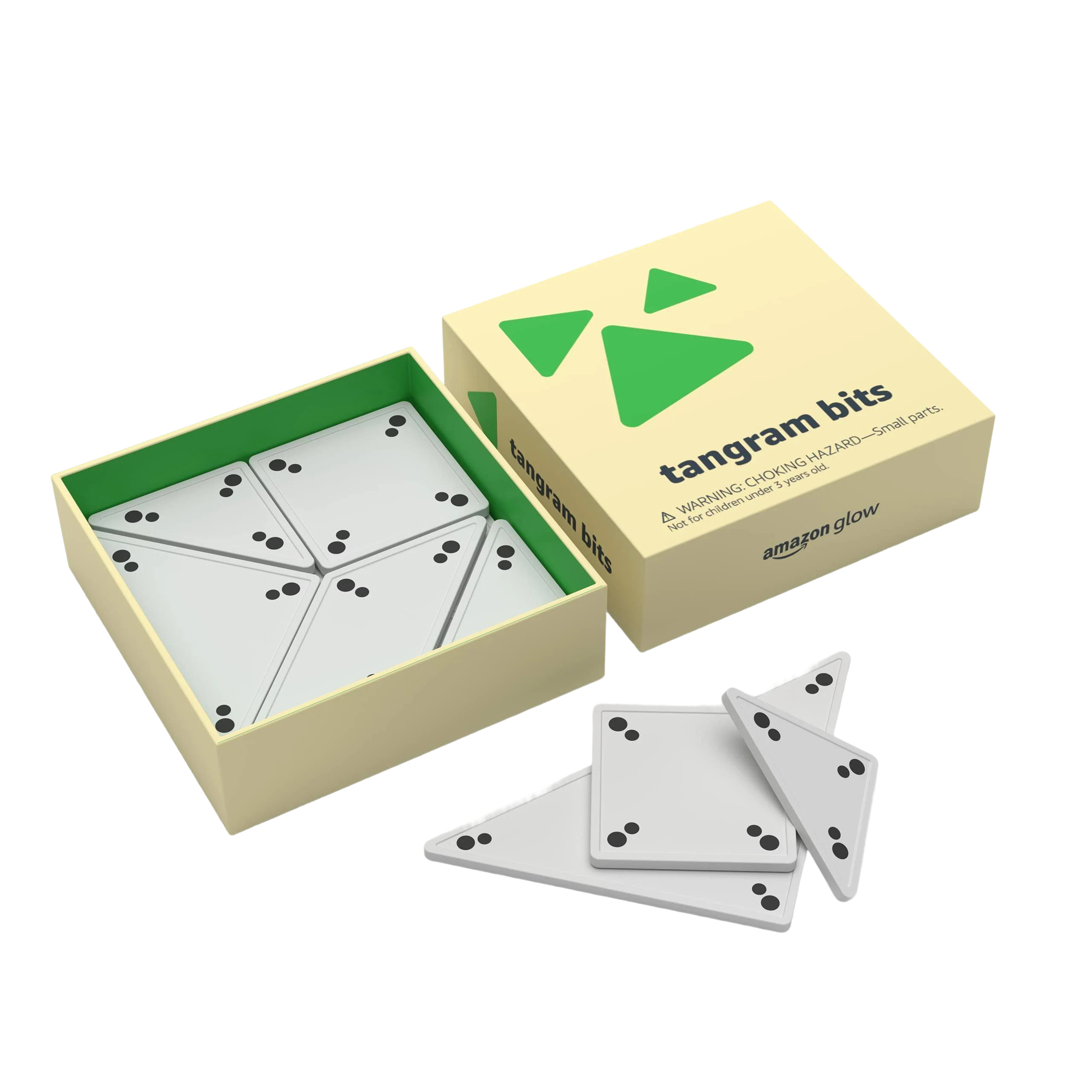
Fig 1.0 - Physical hands, digital magic: the Tangram Bits piece set, and the same pieces in play on Pirate Island.
Architect of “Aha!”
I didn’t just design the interface for Tangrams; I originated the concept. As author of the Game Design Document I defined the core loop—balancing cognitive challenge against the magic of a digital reward—and architected a difficulty curve that let the game grow alongside the child. Unlike a solo puzzle, Tangrams was built as a social bridge, so I developed a “Guided Play” framework: specific affordances that let the remote adult hint, celebrate, and co-create without being in the room.
To move from theory to reality I took the hardware prototyping into my own hands. I 3D-printed the initial test sets and used a Cricut to produce custom stickers with precise fiducial markings. To make sure the computer vision logic was sound, I hand-labeled over 400 individual pieces to build the physical library rigorous playtesting needed. When we lost our Principal Researcher, I stepped in and ran 41 playtesting sessions myself.
The illusion of instant
With 100ms+ of hardware latency you can’t design for precision—you have to design for perception. I built a suite of sensory bridges that hid the technical gaps and made remote collaboration feel immediate.
The “Ghost Piece” hinting system
Direct pointing doesn’t translate across asymmetric devices, so I created a Ghost Piece: when the adult dragged a digital shape on their screen, a low-opacity glowing projection appeared on the child’s mat in real time. Guidance without taking over the child’s play.
Bloom and snap latency masking
A magnetic feedback loop where the environment blooms with light as a hand approaches a target. Firing those cues before the CV finalized coordinates turned a technical delay into a reactive, magical snap.
Asymmetric recovery
I turned failures into mechanics. When a child’s hand occluded a piece’s marker, a “pulse-to-find” cue coached them to move their hand naturally—keeping play in flow and the technology invisible even during sensor dropouts.
Designing for children requires a different definition of precision. The algorithms could hit 99% accuracy in a lab; I pushed for heuristic fail-safes so that when the system did fail, it failed gracefully instead of breaking the child’s flow.
Specs the dev team could actually use
Beyond flows and wireframes, I recorded narrated prototype walkthroughs for every major feature. The dev team could reference interaction nuance and timing at their own pace, which cut QA cycles and the back-and-forth that usually eats a build.
Fig 2.0 - The wireframe spec, page by page, and one of the narrated walkthroughs that shipped alongside it.
One game, every screen in the house
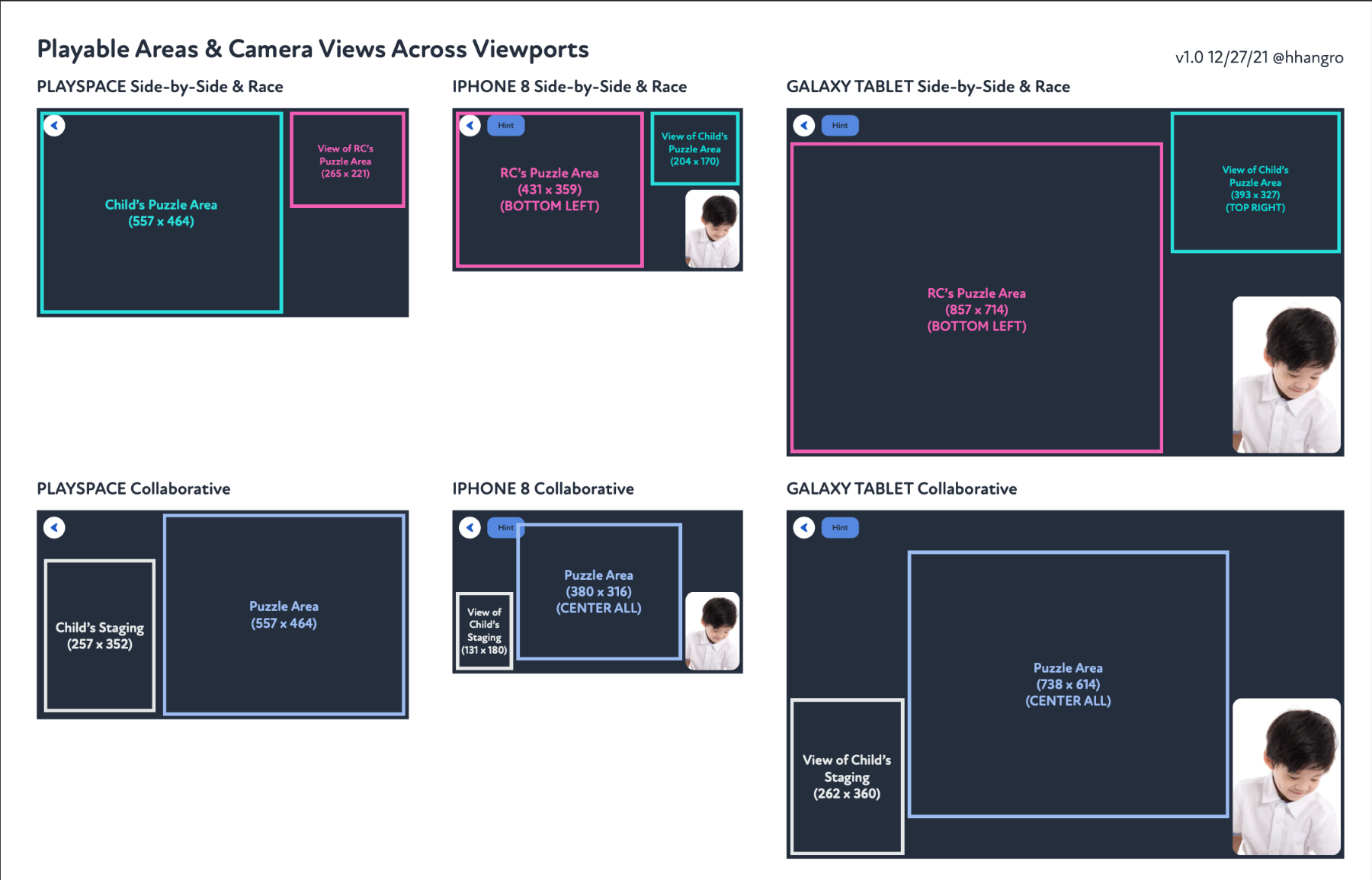
The child’s side was fixed hardware. The remote adult’s side was whatever they already owned—iOS or Android, phone or tablet. Every combination changed the aspect ratio, the safe area, and how much of the puzzle the camera could actually show, so a layout that felt generous on an iPad clipped pieces on a small Android phone. I measured the playable area and camera view for each supported device and specced the game against the tightest one, then let the scene breathe outward from there.
Alone, together, and the seam between
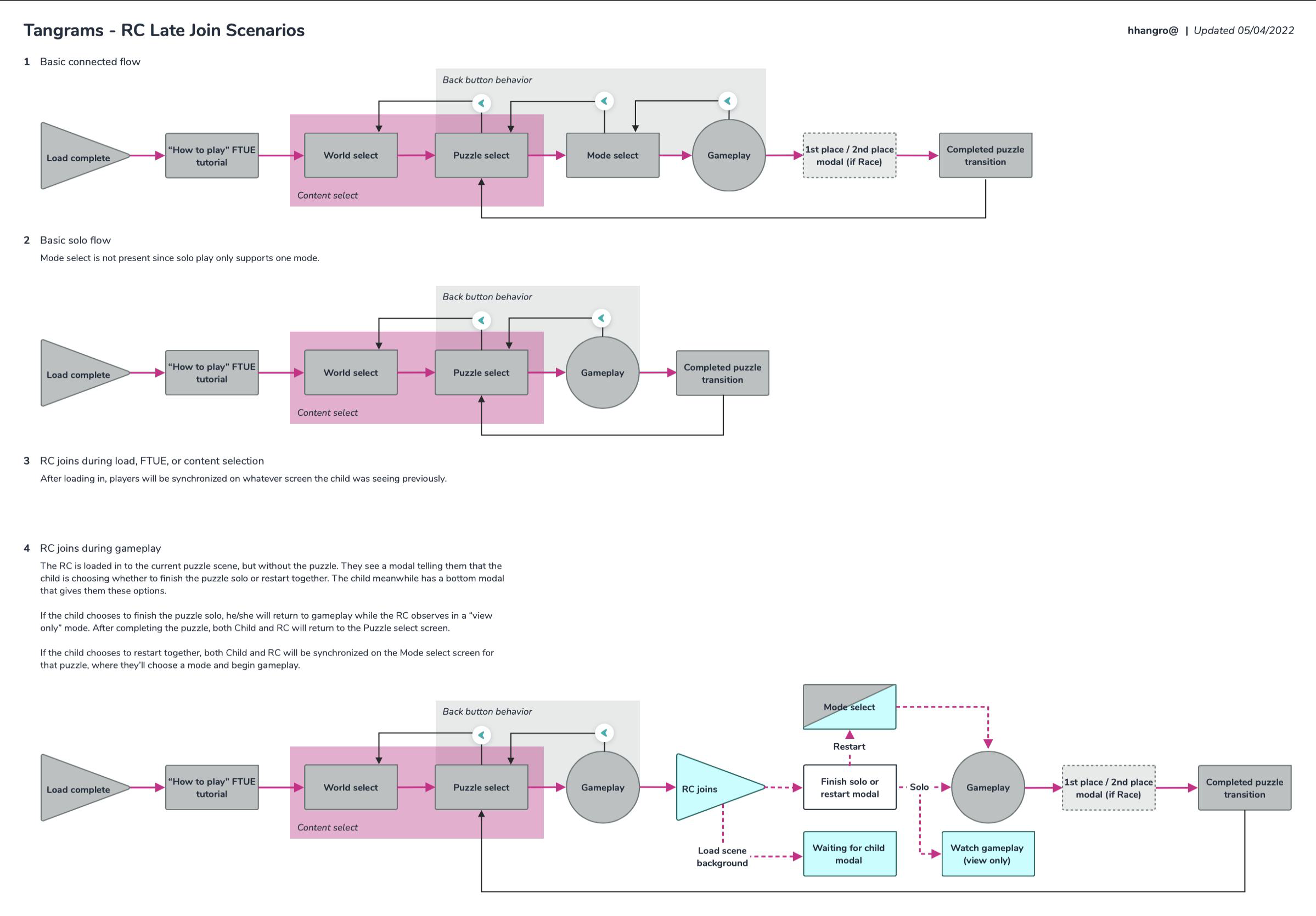
The Glow had to be just as good alone as it was together. A kid might open Tangrams solo on a Tuesday afternoon and have Grandma drop in halfway through a puzzle—so every screen needed a solo state, a connected state, and a graceful path between them. Who owns the puzzle when a second player arrives mid-solve? Does the child get to finish what they started, or does the pair restart together? What does the adult see while they wait? I mapped every late-join permutation, including back-button behavior and a view-only mode, so nobody ever lost work to someone else’s timing.
Art direction
I built the puzzles and levels in Unity and art-directed a contract illustrator who brought the worlds to life. Incomplete puzzles read as equal-sized tangram outlines; completed ones went freeform, scaled to sit inside the scene.
Pirate Island, shown at the top of this case study, was my personal favorite level.
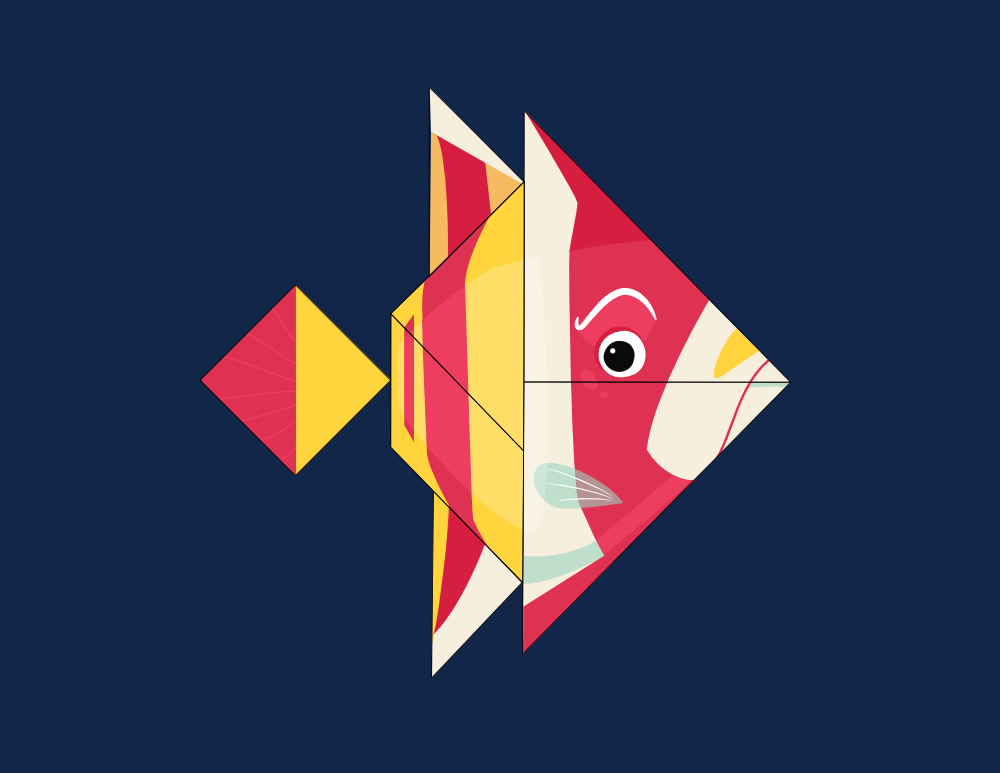

Fig 3.0 - Angelfish: solved shape to freeform character, the reward moment that made finishing a puzzle worth it.
“Tangram puzzles were my daughter’s favorite game... it lets my 5-year-old play games and see her grandparents like they’re in the room together.”
— CNET review
“Honestly I am addicted to this game and play it without my kids. Lots of fun! My kids love the animation after solving a puzzle.”
— Amazon customer review
As the Glow’s inaugural hero activity, Tangrams became the North Star for the platform. By fully leveraging the hardware’s object tracking it set the bar for engagement and validated the Glow Bits ecosystem—directly enabling brand partnerships with companies like Mattel to bring physical play into the digital realm.